The End of an Era: Tim Cook Steps Down as Apple Posts the Best Quarter in Its History
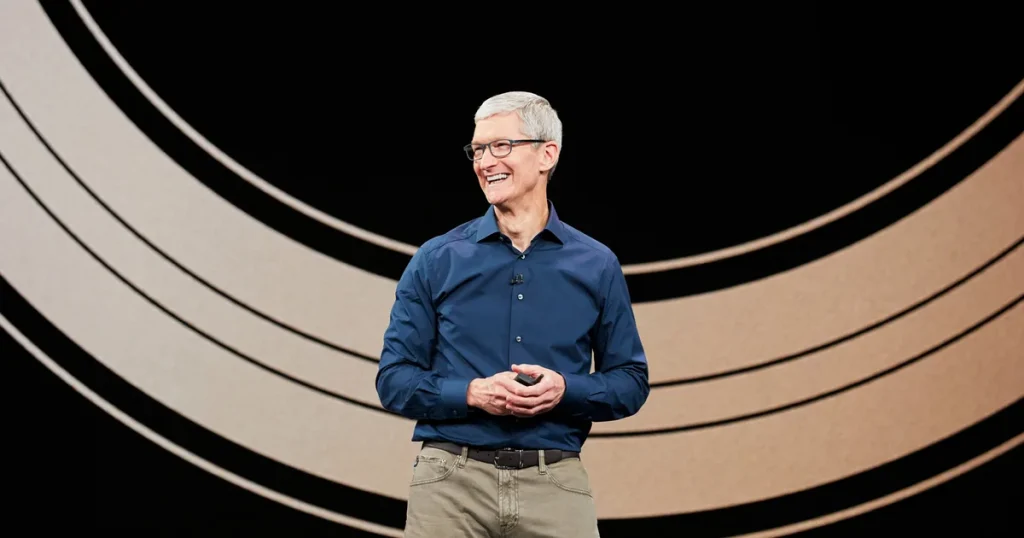
After 15 years and a tenfold increase in market value, the man who turned Apple into a $4 trillion machine is handing over the keys — right as the company faces its biggest AI test yet.
Tim Cook has seen a lot in his 15 years running Apple. He oversaw the launch of the iPad, AirPods, the Apple Watch, Apple TV+, and the landmark transition to Apple Silicon — a chip that forced the rest of the PC industry to rethink what a laptop could be. He grew annual revenue from $65 billion to over $416 billion. He transformed a hardware company into a services machine. And last Thursday, on what was his 89th earnings call, he chose to announce his retirement on arguably the best financial day in Apple's history.
The timing was not accidental. Apple's fiscal Q2 2026 results hit $111.2 billion in revenue — a new all-time record for the company's March quarter, arriving well above the $109.7 billion Wall Street expected. Earnings per share came in at $2.01, up 22% year on year. The stock jumped 4% in after-hours trading. Then, matter-of-factly, Cook confirmed he would step down as CEO on September 1 and move into the role of Executive Chairman.
"I looked at three things," Cook told Fox Business. "The performance of the company in the first half — it's been remarkable. Our roadmap is incredible. And most importantly, we have the right leader ready." The right leader he was referring to is John Ternus, 50, Apple's head of hardware engineering — and a name that has been quietly circulating as the front-runner for the CEO role for years.
"John Ternus has the mind of an engineer, the soul of an innovator, and the heart to lead with integrity and honor."Tim Cook — official Apple press release · April 2026
The numbers behind the exit
It is hard to overstate just how strong Apple's quarter was. iPhone revenue reached $57 billion, up 22% — a March quarter record driven by sustained global demand for the iPhone 17 lineup, including the new iPhone Air. The Services division, which includes the App Store, Apple Music, iCloud, and advertising, set an all-time high of nearly $31 billion, growing 16% year on year. Mac sales climbed 5.7%, boosted by the debut of the MacBook Neo. Greater China grew 28%.
The company also authorized a fresh $100 billion share buyback and raised its quarterly dividend 4% to $0.27 per share. For the eighth consecutive quarter, Apple beat analyst estimates on both revenue and earnings per share. The stock's after-hours reaction — a jump to roughly $282 — put Apple within striking distance of its December record high.
Cook's 15-year scorecard
When Tim Cook took the CEO role in August 2011, Apple was worth approximately $350 billion. Today it sits at $4 trillion — a more than tenfold increase. Annual revenue has grown from $65 billion to over $416 billion. Annual profit has quadrupled to more than $110 billion. The installed base of active Apple devices has grown to 2.5 billion worldwide. Apple's Services segment, which did not meaningfully exist when Cook took over, now generates over $109 billion a year — roughly the same as the entire company did when he arrived.
Who is John Ternus?
If Tim Cook was the man who made Apple's machine run, John Ternus is the man who built the machine itself. Now 50, he joined Apple in 2001 as a junior product design engineer — his first project was a plastic external monitor called the Apple Cinema Display. For the next two decades, he moved steadily up through hardware engineering, eventually leading the development of every major product category in Apple's current lineup.
His fingerprints are on everything: the AirPods, every iPad generation since 2013, the transition of Mac from Intel to Apple Silicon, the Apple Watch hardware from 2022 onwards, and the complete iPhone lineup including the iPhone 17 Pro and iPhone Air. He was the public face of several WWDC hardware announcements and was, in the words of Bloomberg's Mark Gurman — who has reported accurately on Apple for years — widely understood inside the company to be Cook's chosen successor.
Tim Cook — the outgoing CEO
- Joined Apple in 1998 as operations chief
- Succeeded Steve Jobs, August 2011
- Grew market cap from $350B to $4 trillion
- Built the Services business into a $109B engine
- Oversaw Apple Silicon transition (2020–2023)
- First Fortune 500 CEO to publicly come out as gay (2014)
- Becomes Executive Chairman September 1, 2026
John Ternus — the incoming CEO
- Joined Apple in 2001, product design team
- Mechanical engineer, University of Pennsylvania 1997
- Led hardware for iPhone, iPad, Mac, AirPods, Apple Watch
- Drove Mac's transition to Apple Silicon
- SVP Hardware Engineering since 2021
- Described as "charismatic and well-liked" inside Apple
- Becomes CEO September 1, 2026
Before Apple, Ternus worked at Virtual Research Systems — an early VR company building head-mounted displays in the 1990s. That four-year stint exposed him to immersive computing at its earliest experimental phase. It would prove unexpectedly relevant decades later, when he oversaw the development of the Apple Vision Pro. During a 2024 commencement speech at his alma mater, he recalled his first day at Apple: "I wasn't sure I belonged there. The people I met were so smart and so confident… but I'll always be grateful that I wasn't afraid to ask for help when I needed it."
At 50, Ternus mirrors Cook's age when he became CEO in 2011 — a detail Apple's board noted when approving the succession. It positions him for a potential decade or more of leadership, the kind of long-term stability large institutional investors prize above almost anything else.
The one cloud: RAMageddon
Beneath the record figures, Cook raised a warning that his successor will need to confront head-on. Apple, primarily a hardware company, is being squeezed by a global shortage of memory chips — a direct consequence of the AI industry's extraordinary appetite for RAM. Industry analysts have taken to calling it "RAMageddon."
Cook acknowledged that Apple spent more on memory chips in the March quarter than in any previous period. He warned of "significantly higher memory costs" through June and beyond, costs that will "drive an increasing impact" on the business. The effect is already visible in pricing: the Mac mini's entry price has risen from $599 to $799. For a company whose brand is built on premium hardware at predictable price points, sustained component cost pressure is a structural problem, not a quarterly blip.
The deeper irony is that the very technology Apple is now racing to embrace — AI — is also the force disrupting its supply chain. The same data centers training large language models are consuming the exact memory chips Apple needs to build iPhones, Macs, and Apple Watches at scale.
"There's just a little less flexibility in the supply chain at the moment for getting more parts."Tim Cook — Reuters interview · April 30, 2026
The unfinished business: Apple and AI
Of everything Cook leaves behind, the AI story is the most unresolved. Apple entered the generative AI era in 2024 with the launch of Apple Intelligence — an on-device AI suite integrated across iOS, iPadOS, and macOS. The reception was cautious. Writing tools, image generation, and notification summaries arrived on schedule. The transformative, conversational Siri upgrade that Apple had teased at WWDC 2024 did not.
The gap between Apple's AI ambitions and its delivered reality has been a persistent sore point. Competitors moved faster: ChatGPT became a cultural moment; Google's Gemini embedded itself across Android; Samsung shipped AI features Apple had not yet released. For a company that markets its products on the promise of "it just works," the AI lag has been an unusual and uncomfortable position.
Apple's AI partnerships — who powers what
Google GeminiMulti-year deal signed January 2026. Gemini will power the next generation of Siri and Apple Foundation Models. Apple reportedly paying ~$1 billion per year for access.
OpenAI (ChatGPT)Integrated since iOS 18 for text and image generation tasks Siri cannot handle natively. Continues under the new AI strategy.
Anthropic (Claude)Claude integrated into Apple's Xcode developer tools as a "vibe coding" assistant for writing, editing, and testing code.
The January 2026 announcement of a multi-year partnership with Google — giving Apple access to Gemini, the model that scored nearly double GPT-5 Pro on key reasoning benchmarks — was the clearest signal yet that Apple had accepted it could not win the AI model race alone. The new Siri, built on Gemini and expected to arrive with iOS 26.4 this year, promises something the current assistant has never delivered: genuine contextual awareness across apps, memory of previous conversations, and the ability to take complex multi-step actions without repeated prompting.
Cook, in his final months as CEO, was direct about the stakes. "AI is at the top of my list," he told Fox Business, "because I see it as a huge opportunity for us and what we deliver to our users." Whether that opportunity is fully realized will be Ternus's defining challenge — and the metric by which his tenure will be judged.
How Tim Cook rebuilt Apple — and what he leaves behind
When Steve Jobs resigned and named Cook as his successor in August 2011, the skeptics were vocal. Jobs was a product visionary, a performer, a reality distortion field with a turtleneck. Cook was an operations expert — the man who had fixed Apple's supply chain in the late 1990s when the company was months from bankruptcy. Many observers doubted whether operational excellence could substitute for the creative spark that defined the Jobs era.
What followed was one of the most remarkable runs in corporate history. Apple's stock rose more than 1,900% under Cook — outperforming the S&P 500's 503% gain over the same period by a factor of nearly four. Revenue almost quadrupled. Annual profit grew from roughly $26 billion to over $110 billion. The company passed $1 trillion in market cap in 2018, $2 trillion in 2020, $3 trillion in 2022, and $4 trillion in 2025.
The key strategic move was not a product launch — it was a business model transformation. Cook recognized early that Apple's real asset was not the iPhone hardware. It was the 2.5 billion people who owned Apple devices and trusted Apple with their data, their payments, and their attention. He built a services business — the App Store, Apple Music, Apple TV+, iCloud, Apple Pay, Apple Card, advertising — that now generates over $109 billion a year at margins far higher than any hardware product. The iPhone remains the engine. But the Services business is now the flywheel that makes the whole machine compound.
Cook also made two hardware bets that redefined what Apple could build. The first was Apple Silicon — a decade-long project to design processors in-house that culminated in the M-series chips, widely regarded as the best laptop processors in the world. The second was the Apple Watch, which launched in 2015 to mixed reviews and grew into a health platform that today does ECG readings, blood oxygen tracking, and fall detection for hundreds of millions of users.
The succession — how it works
Cook will remain as CEO through the summer, working closely with Ternus on transition. On September 1, 2026, Ternus formally becomes CEO. Cook moves to Executive Chairman of Apple's board — a role that keeps him involved in policy, regulatory engagement, and strategic oversight, without day-to-day operational responsibility. The transition was approved unanimously by Apple's board and described in the official press release as the result of a "thoughtful, long-term succession planning process."
What the next chapter looks like
John Ternus inherits an extraordinarily strong hand. Apple enters his tenure with $45.57 billion in cash, a freshly authorized $100 billion buyback, a record Services business, and the most powerful chip architecture in consumer computing. The question is not whether the machine runs — it clearly does. The question is whether it can evolve fast enough.
The timeline ahead:
Spring / Summer 2026 — New Siri powered by Google Gemini expected with iOS 26.4. First major AI product under Ternus's watch before he is officially CEO.
September 1, 2026 — Ternus officially becomes Apple CEO. Cook moves to Executive Chairman. One of the largest CEO transitions in tech history takes effect.
Late 2026 — Potential large AI acquisition. Apple is reportedly weighing its most significant M&A move in years — a sharp departure from Cook's conservative approach to deals.
2027 and beyond — Memory cost pressures, China dependency, and the AI competitive gap are the three structural challenges Ternus must address to sustain Apple's growth trajectory.
For now, the transition feels calm — even choreographed. Cook is not leaving under pressure. He is leaving at a peak, on his own terms, with a record quarter to his name and a successor he has personally mentored. In the technology industry, that kind of clean handoff is rarer than it should be.
The harder test comes later. Siri has to work. The AI story has to close. And John Ternus — a man who once was not sure he belonged at Apple — has to prove he was always meant to lead it.